- Tel: +86-15305875100
- E-mail: [email protected]
- Please contact us if you have questions.
CONTACT US


 English
 Español

Industry News
Sep 25,2026
Why Does Visibility Matter When Using a Boat Power Switch Panel
A boat power switch panel may look like a small part of a vessel. In daily use, however, it can become one of the most frequently touched areas on board.
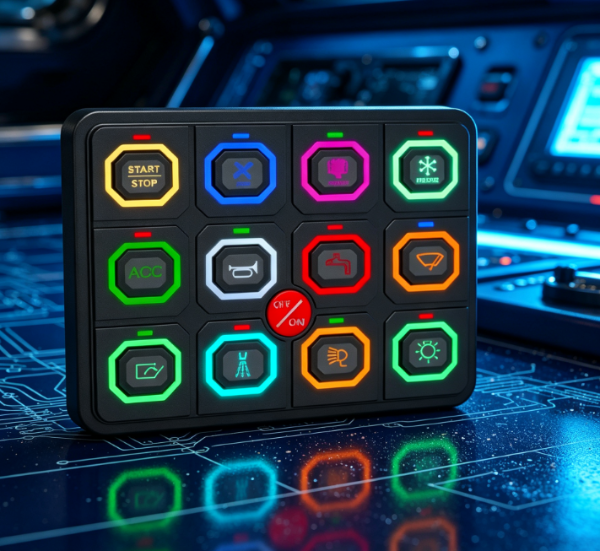
Lights, pumps, horns, power accessories, and other electrical functions may all be controlled from a switch panel. Many boats place these controls near the helm so they can be reached without moving away from the operating position.
This arrangement creates an important question: how easy is it to see the panel when it is being used?
Visibility is not only about making a panel look clear. It affects how quickly a user can identify a switch, understand its function, and recognize whether a circuit is active. This becomes more noticeable when the surroundings are dark, when the boat is moving, or when the operator needs to make a quick adjustment.
A well-organized Boat Power Switch Panel can therefore be viewed as part of the overall user experience on a vessel. Its switches, labels, indicators, and layout all influence how people interact with onboard electrical equipment.
Why Is Visibility Important on a Boat Power Switch Panel?
A switch panel is designed to bring several controls into one location. This makes operation more convenient, but it also means that several switches may appear next to one another.
Without clear visual information, it can take more time to identify the correct control.
This may not matter much during a quiet afternoon on the water. It becomes more important when lighting conditions change. A panel that is easy to understand in daylight may be harder to read when the surrounding area becomes dark.
Visibility helps solve this basic problem.
Clear labels can show what each switch controls. Visible indicators can help show whether a function is active. A sensible arrangement can make related controls easier to recognize.
Boat power panels are commonly used to consolidate controls for functions such as navigation lights, bilge pumps, aerator pumps, and other accessories. This means that the panel is not simply a collection of switches. It is a central point where users interact with several parts of the vessel.
The clearer this point of interaction is, the easier it can be to understand what is happening.
This is why visibility should be considered alongside switch design and electrical organization.
How Does Panel Visibility Affect Everyday Boat Operation?
Boating involves changing conditions.
The surrounding light can shift from bright daylight to shade, dusk, or darkness. A user may also move between an open deck and a darker cabin area. These changes can affect how quickly a switch or label can be recognized.
A visible panel gives the operator a clearer reference point.
Imagine several switches arranged across a dashboard. One controls a light. Another operates a pump. Another controls an accessory. If the labels are difficult to read, the user may need to look closely at each switch before making a selection.
That creates unnecessary hesitation.
A clearer panel makes the relationship between the switch and its function easier to understand. The user can locate the desired control without spending too much time examining the entire panel.
This is especially relevant when the panel is positioned at the helm. The helm is where many operating decisions take place, so electrical controls need to remain easy to identify without creating unnecessary distraction. Boat switch panels are commonly positioned near the helm for this reason.
Visibility therefore becomes part of practical operation.
It is not about decoration. It is about reducing uncertainty between the user's intention and the physical control.
What Role Do Labels Play in a Boat Power Switch Panel?
Labels are one of the simplest ways to improve panel visibility.
A switch may have a familiar shape, but its shape does not always explain what it controls. A label gives the user direct information.
For example, a panel may contain controls for lights, pumps, accessories, or a horn. If each function is clearly identified, users do not need to rely entirely on memory.
This becomes especially useful when a boat has several controls that look similar.
Labels can also help when different people use the same vessel. A boat owner may know the location of every switch, while another operator may not. Clear identification gives both users the same basic reference.
The position of the label matters as well.
A label placed too far away from its switch may create uncertainty. A crowded group of labels can have a similar effect. The visual relationship between the switch and its description should be easy to understand.
| Visibility Element | Main Purpose |
|---|---|
| Switch Label | Identifies the function of the control |
| Indicator Light | Shows the status of a function |
| Switch Position | Helps users locate the control |
| Panel Layout | Organizes related functions |
| Contrast | Helps labels and controls stand out |
| Backlighting | Supports operation in darker conditions |
A simple labeling system can therefore make a panel easier to use without changing its basic function.
How Does Nighttime Visibility Change the User Experience?
Darkness changes the way people interact with controls.
During the day, natural light can make labels and switches easy to see. At night, the same panel may become much harder to read. This is one reason illuminated switches and indicators are commonly used on marine switch panels. Some boat systems use lighted switches specifically to make controls easier to identify in low-light conditions.
But nighttime visibility involves a balance.
A panel needs to be visible without becoming an unnecessary source of glare. Too little light can make the controls difficult to identify. Too much light can draw attention away from the surrounding environment.
This is particularly relevant at the helm.
The operator needs to look at the controls while also paying attention to the water and surroundings. A panel that provides useful information without creating excessive visual distraction can make the operating experience more comfortable.
The purpose of illumination is therefore not simply to make the panel brighter.
It should help answer simple questions.
Which switch is this?
Is the function active?
Where is the control I need?
When these questions can be answered quickly, the panel becomes easier to use in changing light conditions.
Can Switch Indicators Make Electrical Status Easier to Understand?
Visibility is not limited to reading labels.
The user may also need to know whether a function is currently active. An indicator can provide that information without requiring the user to test the connected equipment.
This is useful because some electrical functions are not always visually obvious.
A light may be outside the operator's direct field of view. A pump may be installed below the deck. An accessory may be located in another part of the boat. In these situations, an indicator on the switch panel can provide a simple status reference.
Some marine switch panels use illuminated switches to indicate an active circuit.
The value is easy to understand.
The switch tells the user where to control the function. The label explains what the function is. The indicator provides additional information about its current state.
These three elements work together.
However, indicators should remain easy to interpret. If every switch uses a similar light without clear meaning, the panel may still be confusing. The visual language should remain consistent across the panel.
A user should not have to guess what an illuminated symbol or color means.
Clear design makes the information more useful.
Why Does Panel Layout Matter as Much as Illumination?
A panel can have visible switches and still be difficult to use if the layout is confusing.
Visibility involves the whole visual structure.
Related controls can be arranged in a logical way. Labels can stay close to their switches. Frequently used controls can be placed where they are easy to reach. Less frequently used functions can be separated from controls that require more immediate attention.
This kind of organization can make a panel feel easier to understand.
Consider a panel containing controls for lighting, pumps, and accessories. If these functions are placed without any clear relationship, the user has to search across the entire panel.
If the controls are visually grouped, the user can narrow the search.
This is why switch panel design is closely connected with usability. Marine panel specialists note that switch layout can affect both convenience and operation, especially when a dashboard contains many electrical controls.
The panel should communicate its structure visually.
A user should be able to look at it and understand how the controls are organized.
This does not require a complicated design.
Sometimes a simple layout is easier to understand than a panel containing too many visual elements.
How Can Visibility Support Safer Electrical Control?
Visibility can also influence how confidently users operate electrical functions.
A person who cannot clearly identify a switch may hesitate or activate the wrong function. This can be inconvenient and may become more important when the controlled equipment has an operational role.
Clear identification helps reduce this uncertainty.
For example, navigation-related controls may need to be distinguished from cabin lighting or other accessories. Pump controls may also need to be easy to recognize when they are used during changing conditions.
A clear panel gives each function a defined visual location.
This does not mean visibility alone determines safe operation. Electrical protection, correct installation, appropriate equipment selection, and proper operating practices remain important.
Visibility simply supports the human side of the system.
A boat is operated by people, not by the switch panel itself. Even a well-designed electrical system still depends on the operator being able to understand and use its controls.
This makes visual clarity an important part of the interaction between the user and the electrical system.
The idea is straightforward: when a control is easier to identify, the user has more information before making an action.
What Should Designers Consider When Improving Boat Power Switch Panel Visibility?
Improving visibility does not necessarily mean adding more lights or more visual elements.
A better approach is to consider the entire panel as an interface.
Several practical questions can help guide the design:
Can each switch be identified quickly?
The function should be clear without forcing the user to study the panel for too long.
Are labels easy to associate with their switches?
A clear relationship between text and control reduces confusion.
Can active functions be recognized?
Indicators can help users understand the current state of a circuit.
Does the panel remain understandable in low light?
Nighttime use should be considered rather than treated as an afterthought.
Does the illumination create unnecessary distraction?
Useful visibility should not become excessive glare.
Are related controls grouped logically?
Organization can make the entire panel easier to scan.
Can different users understand the panel?
A good interface should not depend entirely on the owner's memory.
These considerations show that visibility is connected with more than the appearance of a Boat Power Switch Panel.
It involves information, organization, operation, and user habits.
As marine electrical systems become more integrated with lighting, pumps, accessories, navigation functions, and other onboard equipment, the switch panel remains an important point of interaction.
The discussion around panel design is therefore moving beyond the simple question of how many switches a panel can contain.
It is also about how clearly those switches communicate with the person using them.
A Boat Power Switch Panel that is easy to see can make the control area easier to understand. Clear labels can identify functions. Indicators can show status. Logical placement can reduce searching. Appropriate illumination can support operation when natural light is limited.
These details may appear small when considered individually.
Together, they shape how a person experiences electrical control on a boat.
Related Products
Looking For Business Opportunity?
Request for a call today

No.128, Qianjin Road, Qianfeng Industrial Zone, Tangxia Town, Ruian, Zhejiang, China
-
-
Sophia Ye
-
Phone: +86-15305875100
-
WhatsApp: 15305875100
-
Email: [email protected]
-
- Mobile Terminal
Copyright 2024 Zhejiang Xiangrui Auto Electric Co., Ltd.

Relays And Modified Parts Factory
