

 English
 Español
Home / News / Industry News / Understanding Boat Dual Battery Isolator Functions in Modern Marine Applications
- Tel: +86-15305875100
- E-mail: [email protected]
- Please contact us if you have questions.
CONTACT US

Industry News
Jun 19,2026
Understanding Boat Dual Battery Isolator Functions in Modern Marine Applications
On most modern boats, electrical systems are no longer kept simple. Even small vessels now carry multiple devices that depend on stable and predictable power. Lights, navigation units, communication tools, and onboard accessories often run at the same time or in quick shifts.
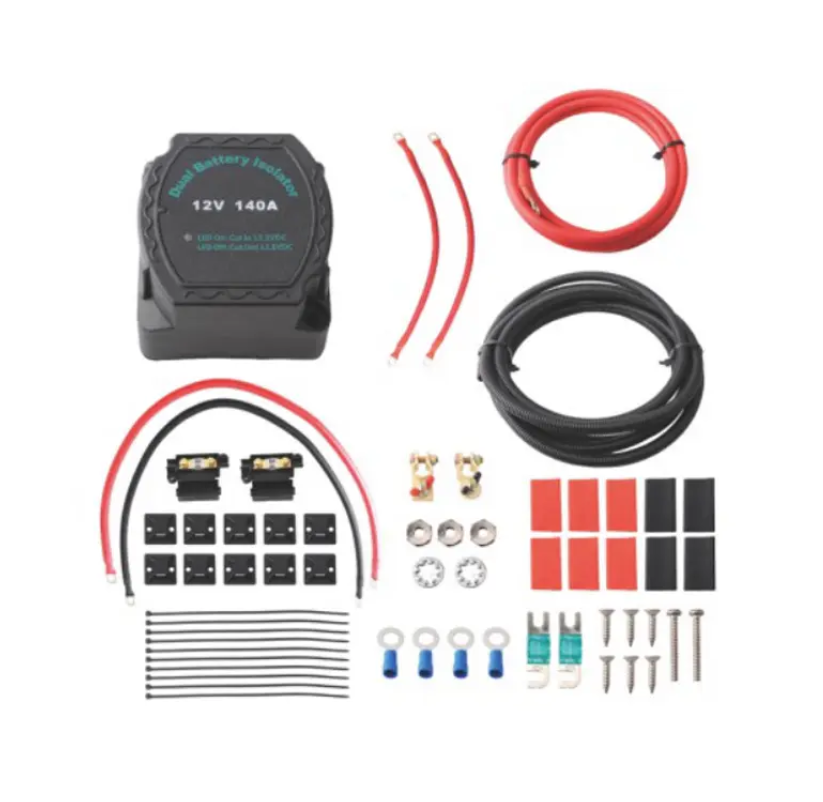
Because of this, battery setup has slowly changed from a basic choice into a structural decision. Two batteries are commonly used instead of one. They do not behave the same way, and they are not meant to.
Between them sits a small component that rarely gets attention. The boat dual battery isolator . It does not generate power. It does not store energy. It only influences how energy moves between two sources that already exist.
That influence is more important than it first appears.
Why do boats separate power into two batteries?
In real operation, a boat does not consume energy evenly.
Starting an engine creates a short but heavy demand. After that, power usage drops into a more stable pattern where electronics take over. Later, everything may sit idle, then suddenly shift again.
A single battery can handle this, but the stress pattern becomes uneven. Repeated cycles of strong and light demand tend to affect stability over time.
Splitting the system into two batteries is a simple way to reduce that pressure.
One battery is kept close to starting functions. The other is allowed to handle everyday onboard consumption.
The idea is not complexity. It is separation of behavior.
What the dual battery isolator is actually doing?
Placed between the two batteries, the isolator works quietly in the background.
It does not force energy to move. It only allows movement under certain conditions.
Sometimes the batteries stay independent. Sometimes they support each other. The difference depends on how the system behaves at that moment.
What matters is that the connection is no longer uncontrolled.
Without it, both batteries can interact freely. With it, interaction becomes structured.
That structure is not visible, but it affects how stable the whole system feels during use.
What changes when there is no control between batteries?
Without an isolator, the two batteries can behave like a shared pool of energy.
One battery may begin to take more load simply because conditions allow it. The other may remain less active. This imbalance does not happen instantly, but it builds slowly through repeated use.
There is also a less obvious issue. When charge levels differ, energy can shift between batteries in ways that are not always useful for operation.
The result is not immediate failure. It is unpredictability.
On water, unpredictability is often more noticeable than technical limitations.
How controlled separation changes daily operation?
Once a dual battery isolator is added, the system becomes more structured in behavior.
Each battery starts to follow a more defined pattern.
One tends to focus on short, high demand moments. The other stays with longer, continuous usage.
They still exist in the same system, but they stop interfering with each other in the same uncontrolled way.
In practice, this reduces the need for manual attention. The system organizes itself based on internal conditions rather than operator intervention.
What happens during different boating conditions?
A boat rarely stays in one state for long.
At dock, power demand is light and scattered. During travel, it becomes more continuous. During engine start, demand spikes sharply for a short moment.
The isolator reacts to these shifts without being actively controlled.
It allows one battery to step forward when needed, while keeping the other protected from sudden load changes.
This switching behavior is not dramatic. It happens quietly in the background, without visible indication.
Where this component fits inside the system layout?
Physically, the isolator sits between the two batteries, often placed where wiring paths naturally meet.
It is not a user-facing component. Most of the time, it is hidden inside the electrical layout of the boat.
Its position is chosen for practical reasons. Shorter connections reduce unnecessary complexity. Fewer long paths also help keep the system easier to manage during installation.
In compact boats, this becomes even more important because space is limited and routing options are fewer.
How it affects long-term battery behavior?
Over time, batteries rarely age in exactly the same way if they are used differently.
Without coordination, one battery can end up carrying more workload than the other. The difference is not always obvious at first, but it grows gradually.
A dual battery isolator helps reduce that gap.
It does not make both batteries identical. It simply reduces uneven stress patterns caused by uncontrolled sharing.
The result is a more balanced usage history between the two.
That balance matters more than it seems, especially in systems that are used regularly over long periods.
What kinds of small issues it helps avoid?
Some problems in dual battery setups are not dramatic failures. They are small inconsistencies that appear over time.
Uneven discharge patterns are one. Uncontrolled energy movement between batteries is another.
There is also confusion in energy source tracking. When multiple loads are active, it becomes harder to understand which battery is doing what.
The isolator reduces these overlapping behaviors by keeping energy paths more defined.
It does not remove complexity. It organizes it.
Why this function still matters in modern marine systems?
Marine electronics continue to increase inside small spaces. Even simple boats now carry multiple independent systems that need steady power.
As demand grows, structure becomes more important than raw capacity.
The dual battery isolator fits into this shift naturally. It does not add visible complexity. It quietly improves how existing systems interact.
It allows two batteries to behave like separate roles inside the same environment, instead of competing for the same load.
That is why it continues to appear in modern marine designs without drawing much attention, even though it plays a steady role in keeping everything running in order.
Related Products
Looking For Business Opportunity?
Request for a call today

No.128, Qianjin Road, Qianfeng Industrial Zone, Tangxia Town, Ruian, Zhejiang, China
-
-
Sophia Ye
-
Phone: +86-15305875100
-
WhatsApp: 15305875100
-
Email: [email protected]
-
- Mobile Terminal
Copyright 2024 Zhejiang Xiangrui Auto Electric Co., Ltd.

Relays And Modified Parts Factory
