- Tel: +86-15305875100
- E-mail: [email protected]
- Please contact us if you have questions.
CONTACT US


 English
 Español


Industry News
Nov 27,2026
What Causes Coil Overheating in an Electric Solenoid Switch
A coil too hot to hold a finger against, a faint scorched smell near the cabinet door, a valve that answers a beat late: these signs usually show up well before a switch gives out. An Electric Solenoid Switch turns current into magnetic pull, and the winding that does this work also warms up. When that warmth outruns what the housing and enclosure can shed, insulation ages quickly and switching becomes erratic. Technicians who look after Panel Control Components save time and money when they trace the true source of heat before swapping parts.
Where Heat Comes From in an Electric Solenoid Switch
Current passing through the coil builds a magnetic field that draws in a movable iron core or armature. Resistance in the copper winding converts part of the electrical energy into heat. A modest temperature rise is a normal result of this process.
Problems begin when heat production exceeds heat loss. Several conditions set that balance:
- Supply voltage and current: these fix the power dissipated in the winding.
- Coil resistance and construction: wire gauge and turn count shape the electrical behavior.
- Energizing time and switching rate: long holds or rapid cycling add heat.
- Ambient temperature: a warm cabinet leaves little room for heat to escape.
- Housing and mounting: metal brackets and open space carry heat away, while cramped mounting traps it.
A warm coil is not a faulty coil by default. Its temperature should be judged against the maker's specification, insulation class, and allowed operating conditions.
Typical Causes of Coil Overheating
Rarely does one cause explain every case. Electrical mismatch, control habits, mechanical faults, and cabinet layout each play a role.
Supply Voltage Outside the Rated Range
A DC coil fed above its rating draws more current and dissipates more power, which stresses the insulation. This happens when a replacement coil carries a different voltage mark, when a power supply drifts, or when an AC coil is connected to a DC source. Compare the nameplate value with the voltage measured while the switch is energized, because an unloaded reading can look perfectly normal.
Duty Rating That Does Not Match the Job
Some coils are built for short bursts and need rest between cycles. Picture a press that once energized a solenoid only while a part was positioned. After a program change, the output stays on during every wait, and the coil never cools. The thermal load now differs from the one assumed at purchase, so the coil's duty class should be checked against the real control sequence.
Damaged Winding Insulation
Breakdown of insulation between neighboring turns creates an inter-turn short. Current distributes unevenly, one spot heats up, magnetic force weakens, and the damage spreads. Clues include a resistance value that departs from specification, a brown or blackened coil body, a burnt odor, and repeated overheating after supply checks. A resistance test catches some of these faults but cannot rule out every one, so further electrical testing may be required.
Cabinet Ventilation Problems
Power supplies, relays, contactors, and drives often share one enclosure, and each adds warmth. A solenoid mounted next to a transformer or squeezed into a tight row works in hotter air than its rating assumed. Look for crowded devices, vents covered by cable bundles, dust in air paths, and enclosures with weak natural or forced airflow. A correct voltage rating does not guarantee that temperature stays within limits in every cabinet.
Mechanical Sticking
Dirt, wear, corrosion, misalignment, or a weak return spring can keep the armature from moving freely. In an AC solenoid, an armature that fails to seat fully leaves the magnetic circuit in a high-current condition, and the coil heats rapidly. Fitting a new coil does not remove a jammed or misaligned mechanism, so the obstruction itself needs attention.
Diagnosing an Overheating Electric Solenoid Switch
A structured inspection separates electrical, mechanical, and environmental causes.
| Observed Condition | Possible Cause | Inspection Focus |
|---|---|---|
| Coil unusually hot | Excess supply voltage | Compare rated and actual voltage |
| Heat builds over long runs | Duty mismatch | Review energizing time |
| Burnt smell, discoloration | Insulation breakdown | Inspect the coil body |
| Unstable switching | Mechanical sticking | Check armature movement |
| Several devices run hot | Poor ventilation | Review enclosure layout |
| Repeated coil failure | Wrong selection or installation | Review application needs |
Work through the checks in this order:
- Verify the supply. Confirm nameplate voltage and AC or DC type, then measure the supply while the circuit runs. Examine terminals and wiring for looseness, corrosion, or damage.
- Measure coil resistance. Isolate the component and follow the manufacturer's safety instructions. Compare the reading with the specified value, keeping in mind that resistance alone does not describe the winding's full condition.
- Study the sequence. Note how long and how often the coil is energized, and look for outputs left active during standby.
- Inspect the mechanism. With power isolated, check the armature and moving parts for dirt, wear, restricted travel, or poor alignment. Cleaning and adjustment should follow the maker's instructions.
- Assess the enclosure. Look for trapped heat, blocked vents, dust, and crowded placement. A thermal camera can locate hot spots, and the findings should be compared with each component's limits.
Design Factors That Shape Thermal Behavior
Prevention begins at selection. Winding, magnetic assembly, housing, and electrical ratings all influence how an Electric Solenoid Switch behaves in service.
- Winding and insulation: insulation must suit the expected temperature and electrical conditions. Review rated voltage, coil power consumption, insulation class, permitted ambient temperature, and duty classification.
- Magnetic circuit: the shapes of coil, core, and armature affect switching behavior, and restricted movement interferes with normal operation.
- Housing: material, structure, mounting surface, and surrounding space affect heat transfer. The component should be assessed inside its intended enclosure, not on a bench.
| Factor | Intermittent Duty | Continuous Duty |
|---|---|---|
| Energizing pattern | Periodic activation | Extended energized state |
| Cooling need | Depends on specified off-time | Built for sustained operation |
| Verification | Intermittent rating | Continuous rating |
Matching the coil to the real operating pattern avoids needless thermal stress.
Panel Control Components and Thermal Planning
An Electric Solenoid Switch never works alone. Its electrical and thermal conditions depend on neighboring Panel Control Components, wiring, and enclosure design.
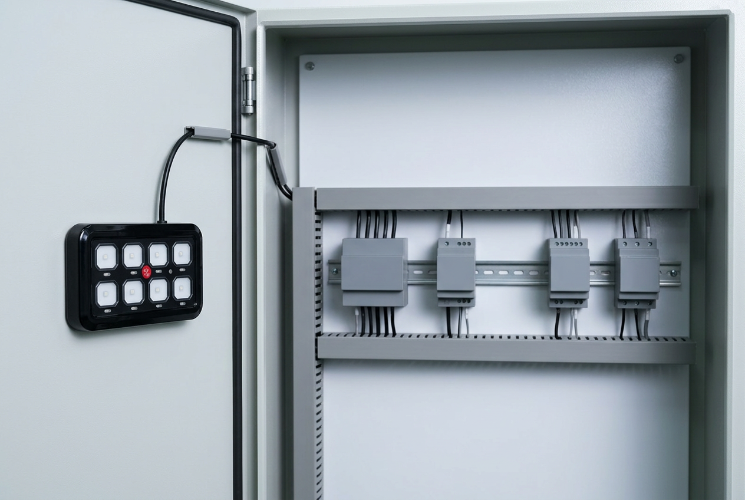
- Coordinate ratings: confirm rated voltage, supply type, output compatibility, and coil current, then select suitable circuit protection. A suppression device can limit switching transients when an inductive coil is de-energized, provided its type and connection suit the circuit.
- Plan the layout around heat sources: keep warm devices away from temperature-sensitive ones and route cables so air paths stay open. Where cooling is needed, size it to the real heat load and environment.
- Inspect on a schedule: watch for changes in coil temperature, terminal condition, switching sound, and armature movement. A switch that overheats again after basic checks points to a selection problem, not a bad batch.
Selecting an Electric Solenoid Switch for Industrial Panels
Choosing a switch involves more than matching dimensions. It must fit the circuit, the operating sequence, the installation environment, and the mechanical needs of the machine.
| Evaluation Area | Information to Confirm |
|---|---|
| Electrical compatibility | Rated voltage, AC or DC type |
| Coil characteristics | Power consumption, resistance |
| Thermal requirements | Insulation class, operating temperature |
| Operating pattern | Continuous or intermittent duty |
| Mechanical fit | Mounting, armature arrangement |
| Installation | Enclosure space, ventilation |
| Maintenance | Access for inspection and replacement |
Documentation quality, manufacturing consistency, and compatibility with other Panel Control Components also deserve review. Before replacing an overheated coil, check its electrical rating, duty requirement, mechanical condition, and cabinet environment. A suitable Electric Solenoid Switch is one whose specifications match how it will actually run inside the finished panel.
Related Products
Looking For Business Opportunity?
Request for a call today

No.128, Qianjin Road, Qianfeng Industrial Zone, Tangxia Town, Ruian, Zhejiang, China
-
-
Sophia Ye
-
Phone: +86-15305875100
-
WhatsApp: 15305875100
-
Email: [email protected]
-
- Mobile Terminal
Copyright 2024 Zhejiang Xiangrui Auto Electric Co., Ltd.

Relays And Modified Parts Factory
